 Superior German Shepherd Dogs

What’s The SV?
The “Verein Fur Deutsche Shaferhunde” or SV, is a single-breed registry and the parent club for German Shepherd Dogs. The SV is responsible for the Standard, and the rules for the process of the classification of the breed. In addition, the SV sets the procedures and regulations or “Korordnung” for the breed survey.
All SV rules and requirements are acknowledged and followed by the German clubs (VDH) and international clubs (FCI), including clubs in the United States for German Shepherd Dogs from foreign bloodlines.
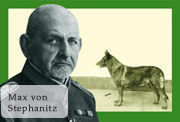
Conceived in 1899, the German Shepherd Dog breed standard was drawn up following suggestions by A. Meyer and Max von Stephanitz, for the structure, temperament, and character. Beginning with Shepherds herding the sheep to Watchdogs, and a planned breeding program based on this standard, the club was established with the goal of producing a high performance working dog.
What is the “Korordnung”?
Korordnung” are the breed survey regulations of the SV. Their purpose is to set the requirements for selection from the breed registry of the SV, a number of dogs that in their character, performance, and anatomical construction appear suitable for the conservation and improvement of the breed. Only such dogs are sanctioned for breeding, and only their off-spring are allowed to be shown, titled, and registered with the SV.
What is the Standard established by the SV?
The German Shepherd Dog (GSD) that corresponds to the Standard offers the observer a picture of rugged strength, intelligence and agility, whose overall proportions are neither in excess or deficient in any way.
The way that he moves and behaves leaves no doubt that he is sound in mind and body and possesses physical and mental traits that render possible an ever-ready working dog with great stamina.
With an effervecent temperament, the dog must be cooperative adapting to every situation, and take to work willingly and joyfully. He must show courage and hardness as the situation requires defending his handler and his property but otherwise being a fully attentive, obedient and pleasant household companion. He should be devoted to his familiar surroundings, above all to other animals and children, and composed in his conduct with people. All in all, he gives a harmonious picture of natural nobility and self-confidence. (from: The FCI Breed Standard-The World Union of German Shepherd Dog Clubs WUSV; translated by judge Fred Lanting, 1998)
What is Schutzhund?
Schutzhund is a German word that refers to a sport that focuses on
developing and evaluating those traits in German Shepherd Dogs that make them more useful and happier companions to their owners.
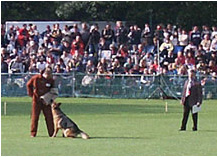
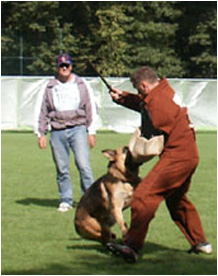
The Schutzhund Breed Evaluation, was developed to demonstrate the strong partnership between humankind and dog. As a working trial, Schutzhund measures the dog’s mental stability, structural efficiencies, ability to scent, willingness to work, courage, confidence, and trainability.
The Schutzhund titles received at these trials (SchH I, SchH II, SchH III,) recognize both the human’s ability to train, and the dog’s ability to perform as required.
On the field, the sport offers an opportunity for dog owners to train their dogs. It is a sport enjoyed by persons of varied professions, ages, and conditions of life, even those with significant disabilities, who join together in camaraderie based on their common interest in working with their dogs. Often, it is a family sport.
What is an “HD” and “ED” designation?
In order to show and breed a German Shepherd Dog must be in the Breed Book kept by the head club, the SV, in Germany. The dog must receive an “a” stamp, HD-normal for hip structure, and if applicable, an ED-normal for elbow structure. These designations are issued after evaluation of x-ray of the dog’s hips and elbows (in dogs born after 2004), conducted after one year of life, and must show structurally perfect to near perfect hips and ,if applicable, elbows. German Shepherd Dogs are only recognized by the SV if they have these designations, registration papers/pedigree, a Schutzhund One title, an AD (endurance test), and a minimum quality evaluation of “Good”, earned at a conformation Show, under an SV Schutzhund judge.
Is a German Shepherd Dog the right choice of breed for me?
Dr. Max v. Stephanitz wrote in his 1925 book – The German Shepherd In Word And Picture , about the first Registered German Shepherd:
”His character corresponded to his exterior qualities, marvelous in his insinuating fidelity to his master; towards all others the complete indifference of a master-mind, with a boundless and irrepressible zest for living. Although untrained in his puppyhood, nevertheless obedient to the slightest nod when at his master’s side, but when left to himself, the maddest rascal, the wildest ruffian and an incorrigible provoker of strife. Never idle, always on the go, well-disposed to harmless people, but no cringer, mad on children and always—in love. He suffered from a suppressed, or better, a superfluity of unemployed energy, for he was then the most tractable of dogs”.
It is important to understand that the German Shepherd Dog is not an “outside” dog. The decision to adopt a GSD should not be made on impulse. They are high energy dogs that enjoy having a job to do. They need to be with their human – a part of the family.
All German Shepherd Dogs require mental and physical stimulation as well as human companionship, socialization, and training. This is not a breed to be left out in the yard, away from its family, isolated or deprived of touch or attention. GSDs are not couch potatoes and they will insist on interacting with their person or family. They will not thrive living in a kennel or outside dog house or garage.
UNLESS YOU ARE LOOKING FOR A NEW FAMILY MEMBER TO SHARE YOUR HOME, LOOK FOR ANOTHER BREED.
What can I expect as my Puppy develops?
Puppies, like all babies, develop each part of each individual in its own time frame. Some parts mature early, some mature late. The only certainty is that eventually it all comes together and they do become a well structured adult.
Skeletal Structure – As with all babies, puppies have soft bones and loose joints. For this reason an age requirement is set for evaluation of hips and elbow joints. In the USA, OFA requires that the dog be at least 2 ½ years old. In Germany, the SV’s “a” stamp requires that the dog be at least 1 year old.
Prior to a year puppy can be easily and permanently damaged if it jumps down or steps from a high place. Things that we may consider normal can be too much for a puppy. The puppy may get up on, but MUST NOT E BE ALLOWED TO GET DOWN FROM. This includes couches, chairs, steps, all vehicles (SUV, vans, trucks, and cars), etc. Puppy must be held back from jumping to prevent injury. Puppy should be lifted off or Puppy’s back end must be held while lowering the front end slowly down.
Dentition– As the baby teeth fall out one by one a space for new tooth may be seen. The Plates move back and forth until all adult teeth have come in, and can give the impression of an over or under bite. Prevention of this natural process could permanently distort the positioning of the jaw and teeth. Prior to one year teeth and jaw position should not be evaluated, and no dental work should be performed.
How can I raise my New Puppy to be what I want in an Adult German Shepherd ?
To rear a dog you must complete what the breeder began. The breeder can indeed lay the foundation of a good and serviceable dog, but the owner as trainer must see to it that they bring their dog to the highest possible development of both the physical and mental foundation already laid.
The puppy needs to be exposed to the outside world, other people, animals, the movement and noises associated with being away from home, as well as, at the very least, basic obedience training.
This well spent time and commitment at an early stage, will in a short period make you the owner of a well behaved and nice-to-be-with dog.
German Shepherd s are naturally protective of their family (pack) and territory. They are extremely loyal. As they grow they reach a period at 9-12 months of awakening of this nature. German Shepherds are sometimes aloof with or suspicious of strangers. At the 9-12 age period they may suddenly become aware of any change in their environment , and will look to their human for calm reassurance that it is OK. Your puppy will file each new awareness away for later use. Do not worry, this is a learning phase and not a permanent change in personality.